
Washington County Juvenile Release Routes
The Washington County Sheriff's Office Temporary Juvenile Holding Facility is a small secure component associated with the Law Enforcement Center. It is distinct from the adult Washington County Jail even though both are linked to the same Sheriff's Office complex. A young person may leave the holding unit in the care of a parent, guardian, or another legally authorized adult. A juvenile court may instead direct transfer, placement, continued detention, or another disposition. A move under that authority is not the same as release to the community.
The public adult active roster and rotating booking reports must not be used as if they cover this facility. Their absence of a juvenile name says nothing reliable about current custody or release. Juvenile case and custody data are subject to different access limits, and the responsible office may need to confirm the requester's authority before sharing any case-specific detail. The official Jail Division page identifies the Sheriff's custodial functions, while the facility's PREA audit provides the clearest public description of the temporary juvenile unit.
Confirm a Washington County Juvenile Release
Case-specific confirmation should start with the relationship to the young person. A parent, guardian, attorney, or other authorized party can contact the Sheriff's Office and the juvenile-court route connected to the matter. Public users should not expect name-based online access. Staff may decline to disclose protected information even when adult arrest data would be public in a comparable situation.
- Contact the Sheriff's jail line and explain that the question concerns the Temporary Juvenile Holding Facility, not the adult jail.
- Be ready to establish identity and legal authority to receive information about the young person.
- Use the case number and juvenile-court contact when a court ordered detention, release, placement, or transfer.
- Ask whether the event was release to an authorized adult or movement to another custodian, without assuming that departure meant community release.
- For a lawful data request, ask the county to identify which records are public, private, or available only to an authorized subject or representative.
Washington County Court Administration is part of Minnesota's Tenth Judicial District. Its public county court contact page lists routing for local court matters. Online MCRO access is not a promise that a juvenile case will appear. Protected juvenile, sealed, and other nonpublic records may be unavailable to a general search.
Note: No public result is not proof that a juvenile was released, transferred, detained elsewhere, or never held.
Washington County Juvenile Facility Contact
The facility is associated with the Washington County Law Enforcement Center. The main jail number is answered around the clock, but a caller should say clearly that the request concerns temporary juvenile holding. For court authority, disposition, or case routing, use Washington County Court Administration. General records staff can explain the proper data request route, but they cannot make restricted juvenile material public merely because a request was filed.
Temporary Juvenile Holding Contacts
Washington County Law Enforcement Center
15015 62nd Street North
Stillwater, MN 55082
Sheriff/Jail: 651-430-7900, answered 24 hours
Sheriff Records Unit: 651-430-7600
Records hours: Monday through Friday, 8:00 a.m. to 4:30 p.m.
Court records: 651-413-8030, option 6
Criminal/traffic: 651-413-8133
Do not send sensitive juvenile facts through an unrelated public form. Call first and ask which secure channel applies. The county's Data Practices page explains its broader government-data process and identifies the county responsible-authority route. An ordinary public-data request is different from the county form for nonpublic data or informed consent.
Washington County Juvenile Custody Profile
The official audit describes a five-bed temporary secure holding facility and reports that a young person may be held for up to eight business days while awaiting disposition. Those details establish scale and function. They do not state that every juvenile remains for that long, nor do they provide a current population count. “Disposition” means the court's resolution or direction for what happens next in the juvenile matter.
The unit is not a second adult jail. Its short-term nature also does not make its records open. Youth status, court rules, identity, the reason for custody, and the requester's role all affect access. Public-facing information should remain at the facility and process level unless the responsible authority lawfully releases more.
The Washington County Data Practices page shows the official request route without exposing any juvenile identity.
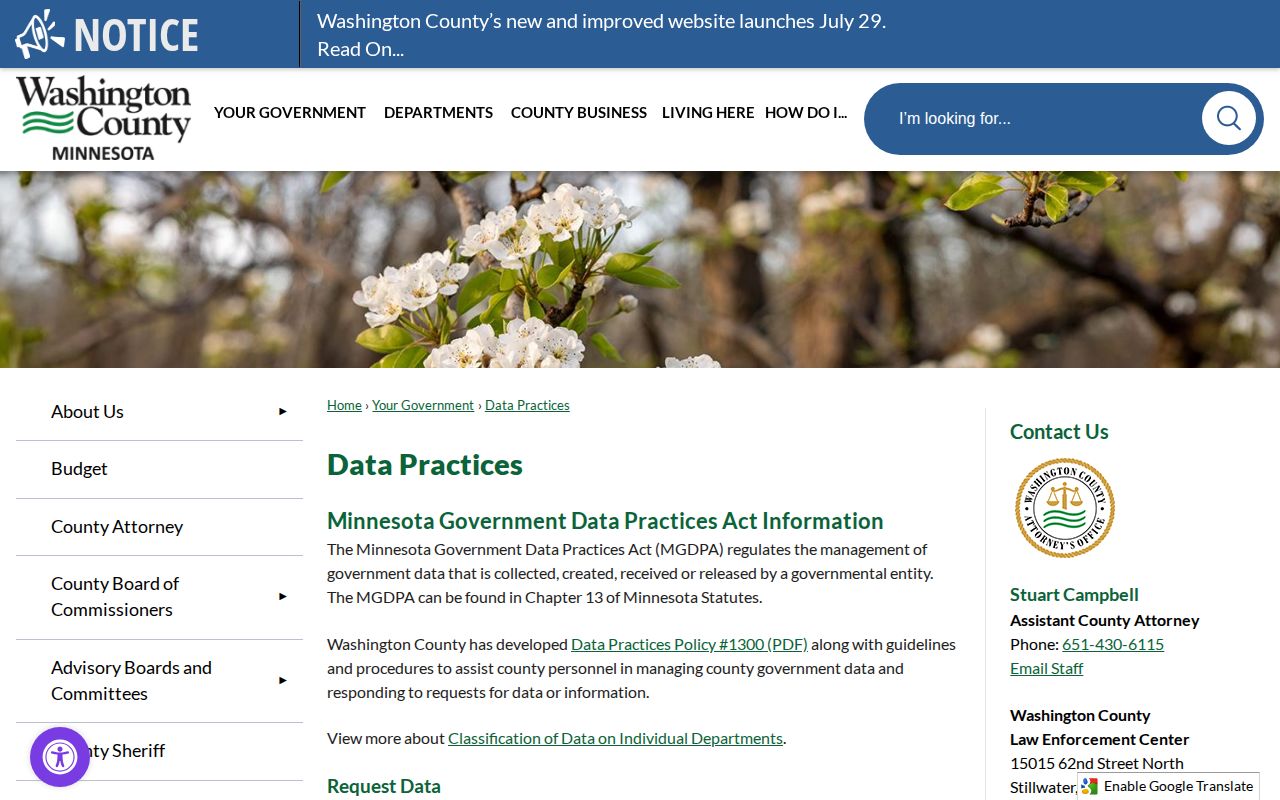
The county page directs requesters to the right process while preserving the distinction between public data and records that require legal authorization.
Washington County Juvenile Record Limits
The adult active roster shows current adult inmates, a generated time, JID and booking details, an estimated release field, and days held. The weekday booking reports show adult booking events, charges, holds, and an actual release date and time when completed. Neither product should be promoted as a way to locate a juvenile. The adult booking-photo request also should not be implied to apply in the same way to a youth record.
| Source | Proper use | Juvenile limitation |
|---|---|---|
| Adult active roster | Current adult county-jail listing | Not comprehensive juvenile custody data |
| Adult booking report | Adult booking interval and release-time field | Not a juvenile release feed |
| Juvenile court | Authorized case and disposition route | Access depends on law and requester authority |
| Sheriff contact | Facility routing and authorized status inquiry | Staff may withhold protected details |
A general description of the facility may be public while a particular young person's name, record, placement, or release plan remains protected. Data classification attaches to the information, not just the building. County staff should make that determination.
Washington County Juvenile Court Release
Juvenile court authority shapes both release and transfer. A judge or authorized court process may direct that a young person return to a parent or guardian, enter a placement, move to another secure setting, or comply with other conditions. The facility carries out that authority. It does not create a public adult-style release reason from which a general user can reconstruct the juvenile case.
Court information should be sought from the court office connected to the case. Even then, access may be limited. Minnesota's public-access rules protect specified juvenile and sensitive material. An authorized lawyer or guardian may have a route unavailable to a member of the public. A caller should provide a case number if known and avoid sharing extra personal information until the office confirms the proper channel.
The Washington County released inmate search is designed around adult county, state, federal, and notification systems. It should not be treated as a substitute for this restricted juvenile process.
Note: A juvenile transfer changes physical location but may leave the young person under continuous court-ordered custody.
Request Washington County Juvenile Data
A narrowly framed request helps the county respond without inviting disclosure of protected data. State the requester's identity and relationship to the youth, the relevant date range, and the type of record sought. Ask which parts, if any, are public and which require consent, a court order, or another legal basis. If access is denied, request the specific authority for the decision and ask whether any public portion can be separated.
Washington County's general Data Practices contact is listed as WCA-datapractices@co.washington.mn.us. The page names the responsible-authority contact and gives the Government Center address. That route is appropriate for classifying a county record request. It is not a way around juvenile confidentiality. The originating agency and court remain the soundest sources for status and disposition questions.
- Authorized adult
- A parent, guardian, or other person legally permitted to receive the youth or specified information.
- Disposition
- The juvenile court's decision or direction about the next legal step.
- Transfer
- A movement to another custodian or placement without release from legal control.
- Public data
- Information the law permits any requester to inspect, distinct from protected juvenile information.
Washington County Facility Release Context
Washington County's facility map includes the adult county jail, this five-bed temporary juvenile holding unit, and two MNDOC prisons. The juvenile unit's role is short-term secure custody pending juvenile disposition, not adult booking or state imprisonment. These facilities share geography, but they do not share one record system. Adult jail releases are verified through Sheriff release data and court records. State-prison releases belong to MNDOC. Juvenile custody changes follow the restricted Sheriff and juvenile-court route.
The adult jail opened in 1993 as a direct-supervision facility. MCF–Stillwater is now subject to a phased closure that has moved many state prisoners elsewhere. Neither fact alters the juvenile unit's access limits. Facility history is useful only when it clarifies which custodian and system hold the record. The safest question is always: which authority had legal custody at the moment being researched?
No federal prison or verified ICE detention center was found in the official Washington County facility materials reviewed. That evidence boundary does not change the need for case-specific juvenile authorization.
Public Record Search
Sponsored Results