
Washington County Release Date Types
Washington County uses two very different online fields. The active inmate roster displays “Release Est.” That value is forward-looking and may change. The daily jail booking report can display “Release Date Time” after a completed physical departure for that booking. One is an estimate; the other is an event field. A missing name on the active roster is neither one.
State prison records add more dates. A projected or scheduled date applies while incarcerated. The actual prison release date marks departure from physical prison custody. Supervision can then begin, and final discharge comes later when DOC jurisdiction ends. A state record showing supervised release confirms the person is out of prison but still serving the community portion of the sentence.
A pretrial Washington County detainee may not have a fixed release date at all. Court orders, bail, holds, dismissal, transfer, and later hearings can control the outcome. The roster’s estimate should not be converted into a promise.
Lookup Washington County Release Dates
First identify the custodian. Washington County Jail and the two state prisons located in the county use different systems. The county roster does not cover Minnesota Correctional Facility–Stillwater or Minnesota Correctional Facility–Oak Park Heights. Conversely, a county-only booking does not create an MNDOC record.
- For Washington County Jail, open the active roster and confirm the person by JID and booking number when available. Record “Release Est.” only as an estimate.
- Review the relevant weekday report from the daily booking landing page. A populated “Release Date Time” supports actual departure for that booking.
- Use MCRO to check the Washington County case order, sentence, bail change, or disposition that may affect timing.
- For a state prisoner, search the MNDOC Public Viewer with the complete six-digit Offender ID when possible.
- If the county calculation or state history remains unclear, request the underlying record from the Sheriff or MNDOC rather than estimating it independently.
The broader Washington County released inmates search explains how to reconcile court, jail, state, federal, and notification records when custody changed.
Note: Newly sentenced state prisoners may take several business days to appear in the MNDOC locator.
Washington County Jail Estimates
The Washington County roster source does not publish a formula or guarantee for “Release Est.” County timing can depend on the court order, sentence credit, bail, outstanding holds, transfer status, or a later legal change. No official Washington County source reviewed supplied a general county-jail good-time formula. Minnesota’s state-prison calculation must not be imported into a county jail sentence.
When the estimate matters, call Washington County Jail at 651-430-7900 or ask the Sheriff’s Records Unit for the order or calculation behind it. The Records Unit is available at 651-430-7600, Monday through Friday from 8:00 a.m. to 4:30 p.m. A focused request can include name and aliases, date of birth if known, JID, booking number, date range, estimated date, actual release date and time, legal basis, and receiving agency if transferred.
The daily report covers a fixed 7:00 a.m. to 7:00 a.m. interval and contains both released and still-held bookings. A blank “Release Date Time” means that report did not show release at generation. It does not prove indefinite custody.
Minnesota Release Date Structure
Minnesota is not an 85-percent truth-in-sentencing state. For most fixed executed felony sentences tied to offenses committed on or after August 1, 1993, section 244.101 sets a baseline minimum imprisonment term equal to two-thirds of the total sentence and a maximum supervised-release term equal to one-third, subject to section 244.05. The state’s official calculation controls each case.
A simple example explains the baseline. A 60-month fixed executed sentence starts with a 40-month imprisonment component and a 20-month supervised-release component before case-specific adjustments. It does not promise release at month 40. Sentence credit, earned incentive release credits, disciplinary confinement, other sentences, detainers, warrants, and special statutes can alter the result.
The successful manifest capture of Minnesota’s executed-sentence statute documents the rule.
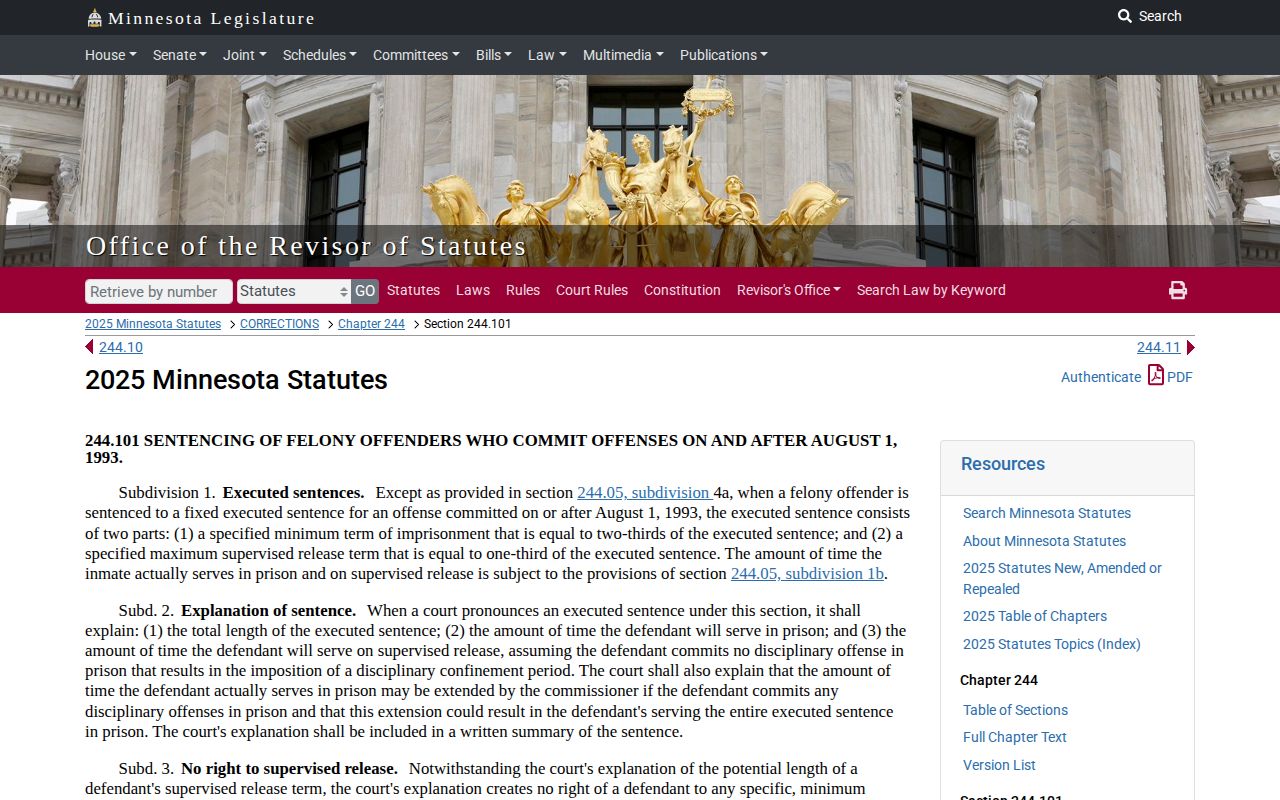
The statute image supports the state-prison baseline only. It is not a calculator for a Washington County jail term.
Washington County Earned Release Credits
For eligible Minnesota state sentences, section 244.44 provides that earned incentive release credits are included in calculating the imprisonment term. Maximum credit is 17 percent of the total executed sentence, and credit cannot reduce imprisonment below one-half of that sentence. The credits are not simply added to or used to erase the supervised-release term.
Credits may be revoked for facility rule violations or criminal acts while incarcerated. Eligibility and the related framework appear in sections 244.41 through 244.45. These rules help explain why a projected date may move, but a public observer should not attempt to recalculate a person’s date from a sentence length alone.
The official earned incentive release credit statute was captured successfully for this page.
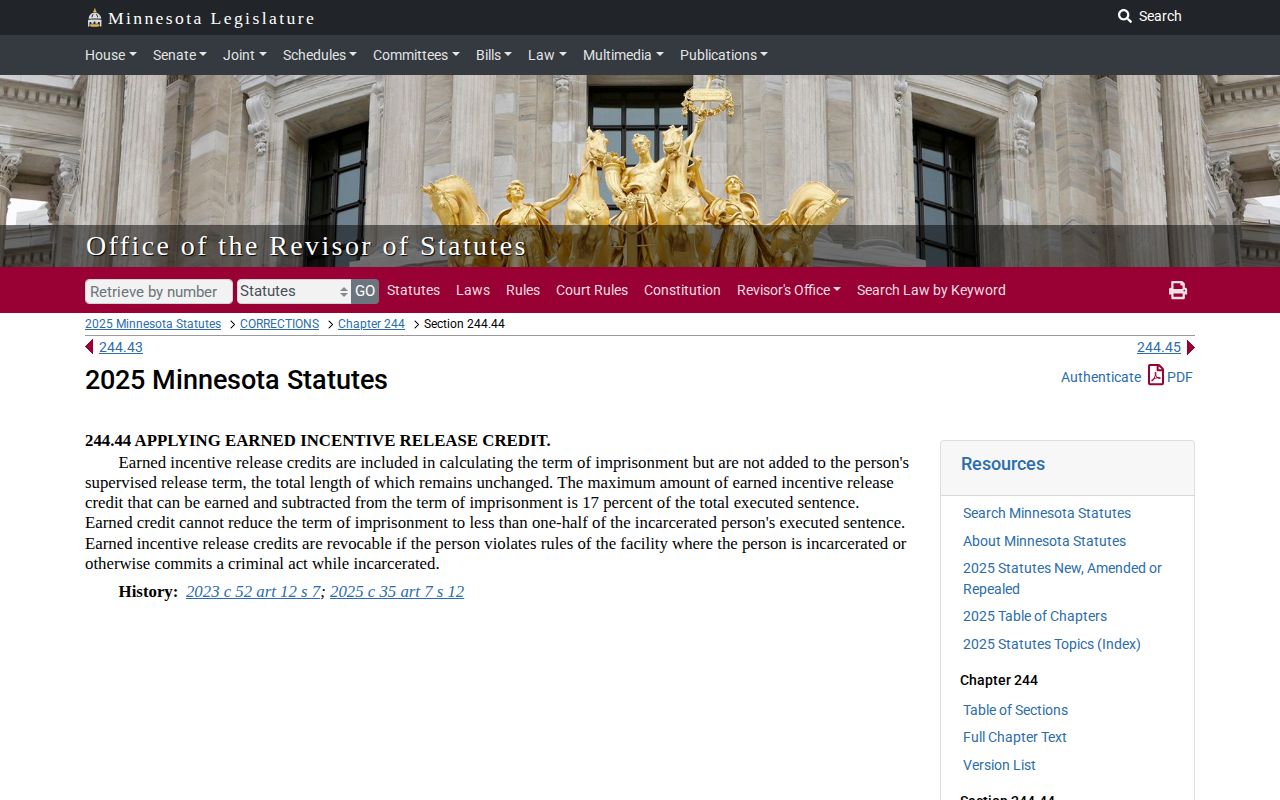
The image shows the governing source behind the credit limits, while MNDOC remains responsible for the individual calculation.
Why Washington County Dates Change
A projected release date is a live administrative result. Several events can move it, change the destination, or turn an expected community release into a transfer. The record should name the event before the date is interpreted.
| Factor | Possible effect | Best source |
|---|---|---|
| Sentence or jail credit | Changes the time credited toward the sentence. | Court order and the calculating agency. |
| Earned incentive credit | May reduce eligible state imprisonment within statutory limits. | MNDOC calculation and offender record. |
| Disciplinary confinement | Can delay state supervised release under section 244.05. | MNDOC record. |
| Detainer or warrant | May cause transfer to another custodian instead of community release. | Holding agency and release record. |
| New court order | May alter bail, sentence, custody, or release authority. | MCRO and certified court record. |
| Other sentence | May keep the person in custody after one term ends. | Court and corrections records. |
A transfer is especially easy to misread. Disappearance from Washington County’s roster or from an MCF–Stillwater location does not prove release. MNDOC is phasing MCF–Stillwater toward closure, and movements to other prisons remain continuous DOC custody.
Minnesota Weekend Release Dates
Section 244.05, subdivision 1a contains an offense-date distinction for qualifying state-prison releases around Fridays, weekends, and holidays. For qualifying offenses before August 1, 1992, the statute can move a scheduled release to the last eligible weekday before the described event. For offenses on or after that date, release occurs on the first eligible day after the scheduled date.
This is MNDOC prison law. It is not Washington County’s general jail policy and should never be used to predict a county detainee’s lobby release. The exact offense date, sentence, and statutory terms matter. Confirm the displayed MNDOC date and the actual release status rather than applying a broad weekend rule.
The official supervised-release and weekend statute was captured through the successful manifest row.
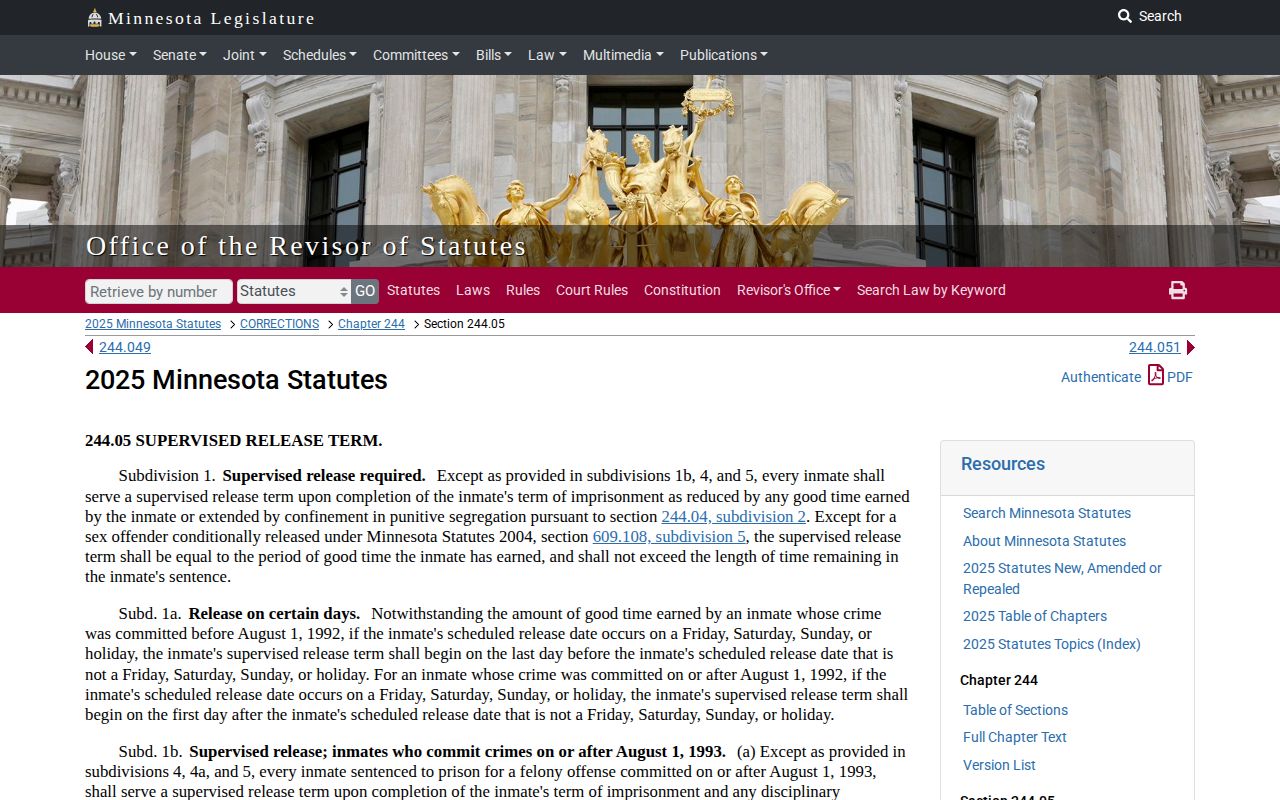
The source documents why offense date can change the applicable timing rule.
Note: Statutory release timing still does not establish that a person entered the community rather than another custodian’s care.
Confirm Washington County Actual Release
After a projected date passes, check the actual status. For Washington County Jail, locate a populated “Release Date Time” in the weekday booking report and request the Sheriff’s public date, time, legal basis, and transfer destination. For a state prisoner, read the MNDOC status, then request the physical prison release type and date, supervision start and end, and final discharge when historical certainty is needed.
A Washington County VINE inmate check can provide a participating custody alert. It cannot prove the legal basis, calculate the sentence, or certify final discharge. The court case can explain a sentence or order but usually does not prove the exact time a jail door opened.
Preserve the agency, label, and timestamp for every field. “Release Est.,” projected release, actual jail release, state supervised release, final DOC discharge, and federal release are distinct facts. Treating them as distinct prevents the most common date error.
MNDOC Release Date Search Fields
The MNDOC Public Viewer searches adults committed to the Commissioner who are incarcerated or have left prison while still under supervision. Search with the complete six-digit Offender ID whenever it is available. Name searches use names associated with convictions and can support prefix-style matching, which means several results or aliases may appear. Confirm the identifier and available descriptors before reading a date.
Record the live status and date labels exactly. The public interface can change, and generic substitutes may blur an important distinction between a projected date, an actual event, and a supervision date. If the record shows community supervision, identify the supervising office. Washington County Community Corrections may be the local office, but location alone does not prove assignment.
A missing result is not proof of final discharge. Newly sentenced people may take time to appear, county-only detainees are outside the database, and fully discharged people may fall outside its stated scope. Request the historical offender record when the person should have a state-prison history but the current locator cannot answer it.
Request Washington County Date Records
For a county booking, give the Sheriff Records Unit enough detail to isolate the correct event: full name and aliases, date of birth if known, JID, booking number, approximate arrest date, and the date range. Ask for the jail summary, actual release date and time, legal basis, release disposition, and receiving agency if transferred. A release date without the receiving custodian can still be mistaken for community freedom.
For a state sentence, MNDOC records staff can be reached through the offender-record request route or at co-records.doc@state.mn.us. Provide identity and Offender ID. Request commitment and admission, prison movements, projected or scheduled date under the system’s actual label, physical release date and type, supervision start and end, and final discharge. Ask for electronic delivery and a fee estimate without promising a response time.
The Washington County daily report and the MNDOC locator are useful public views, but neither is a complete historical certificate. A focused request preserves the event hierarchy and resolves dates that disappeared from a rotating report or current-jurisdiction search.
Washington County Transfer Date Traps
A person can leave Washington County Jail for MNDOC, another county, or another authority. That movement removes the person from local physical custody but is not release to the community. Ask for the receiving agency and check its locator. The same rule applies when an incarcerated person moves between Minnesota prisons.
MCF–Stillwater’s phased closure makes this distinction especially important in Washington County. MNDOC plans full closure by June 30, 2029 and reports that roughly half the population has been moved to other state facilities. A location change during that process is continuous DOC custody. Search the statewide locator before calling it release.
MCF–Oak Park Heights can also receive transfers from elsewhere. A Washington County prison address does not convert a state prisoner into a county detainee, and release from that prison may lead to supervision in another county. Sentence jurisdiction and assigned office control the route.
Public Record Search
Sponsored Results